The Warmest Winter Boots Keep Their Insulation Dry

HOW to avoid cold feet.

Wet insulation is the main reason winter boots get cold. Moisture reaches it from two directions: sweat from your foot and snow or water from outside. VBX boots seal the insulation between two waterproof layers, so it stays dry and keeps its warmth all day. For extreme cold and standing still, the VBX Max is our warmest boot.

Our warmest boots, by condition

Each boot is the warmest option we make for its use. Pick by how cold it gets and how much you move.

Warmest everyday boot · Active use

Bunny Boot VBX Lite - Shale Black

For daily winter life in town or on the homestead: chores, commutes, walking the dog. Stays dry through slush, snow and wet days.

Rated to
-50°F
Insulation
VBX encapsulated
Weight / pair
5-7 lbs
Colors
7 colors
$259.00
Shop VBX Lite
Warmer than Lite · Not as extreme as Max

Bunny Boot VBX Neo - Shale

A step up in warmth from the Lite without going to Max-level extreme. Taller profile with a full neoprene lining.

Rated to
-72
Insulation
VBX encapsulated
Weight / pair
3.5- 5 lbs
Colors
Alpine Green, Shale Black
$339.00
Shop VBX NEO
Tough cold · Composite toe

Bunny Boot VBX Composite

Built for tough cold with a composite toe, for jobs where toe protection matters.

Rated to
-76
Insulation
VBX encapsulated
Colors
Shale Black
The number one failure point

Why winter boots get cold: wet insulation

Insulation keeps you warm by trapping still air. Once it takes on water, it packs down, the air escapes, and heat leaves your foot. Most insulated boots let moisture reach the insulation from both sides.

01

From the inside: sweat

Your feet sweat even in deep cold. In a standard boot that moisture moves outward into the liner and insulation, and it builds up over a day of wear.

02

From the outside: snow and water

Overflow on the ice, slush, melting snow on the boot, wet grass in a blind. Seams, stitching and worn shells let water in over time.

03

The result: lost warmth

Damp insulation compresses and conducts heat away. The boot feels warm at the truck and cold by mid-morning. Drying it out takes hours you rarely have in the field.

VBX Vapor Barrier X

How VBX keeps insulation dry from both sides

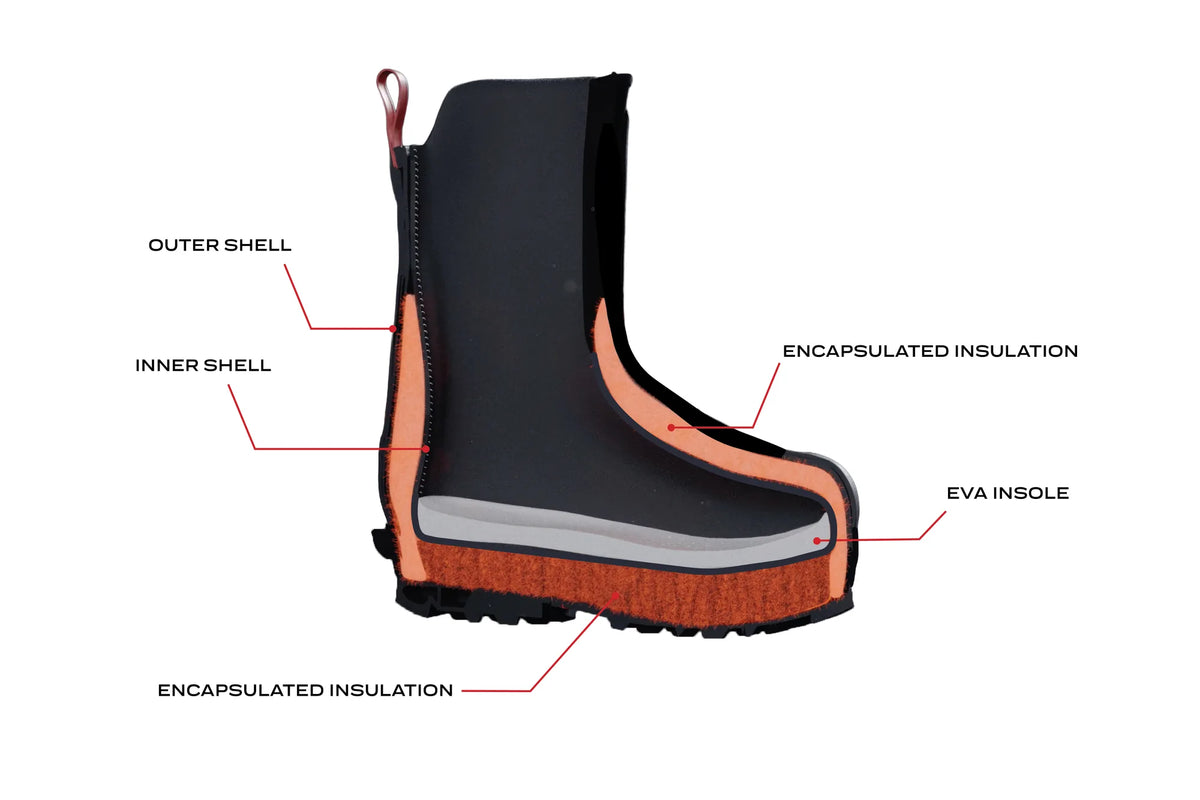
VBX fully encapsulates the insulation between two sealed layers. The inner layer blocks sweat. The outer layer blocks snow and water. The insulation sits sealed in the middle, dry, holding its loft and its warmth for as long as you are out.

  • Sealed inner layer. Foot moisture stays on the foot side, where a sock change handles it.
  • Sealed outer layer. Overflow, slush and snowmelt stay outside the insulation.
  • Dry insulation, all day. Warmth at hour eight matches warmth at hour one.
  • Nothing to dry out. Insulation that never gets wet is ready the next morning.

The design traces to sealed insulated boots built for Marine Corps ground troops during the Korean War frostbite crisis. Read the Bunny Boot story

Cutaway of a VBX boot showing insulation sealed between two waterproof layers.

Comparing Winter boot insulation

Cold feet usually come from wet insulation. Here is where water and sweat end up in each type of boot.

Boot type Water from outside Where your sweat goes After a long wet day
Pac boot (removable felt liner) Stays out unless it gets in at the top or through seams Soaks into the felt liner Pull the liner and dry it before the next day
Insulated boot with waterproof membrane Blocked by the membrane Depends on the design, and some can reach the insulation Varies by boot
Neoprene rubber boot Blocked by the rubber Stays trapped inside with little way out Air out the interior
VBX encapsulated insulation Stopped by the sealed outer layer Stays on the foot side of the inner barrier Insulation stays dry, so you only swap damp socks

Warmest winter boots FAQ

What is the warmest winter boot?

The warmest boot is the one whose insulation stays dry the longest. The VBX Max seals its insulation between two waterproof layers and adds a thick EVA sole against cold from the ground, built for extreme cold and long periods of standing still.

Why do my feet get cold in insulated boots?

Usually because the insulation has taken on moisture, from sweat inside or water outside. Wet insulation loses the trapped air that keeps you warm.

Do my feet sweat in vapor barrier boots?

Your feet sweat in any boot. In a VBX boot that moisture stays on the foot side of the barrier and never reaches the insulation.

What are the warmest boots for ice fishing?

Boots built for standing still on ice need dry insulation and a thick sole between your foot and the ice. That is the VBX Max.

How cold are VBX boots rated for?

VBX boots are rated from -5°F to -79°F, depending on the model. The VBX Max is our warmest at -34°F to -79°F, followed by the VBX Composite (-30°F to -75°F), and the VBX Lite (-5°F to -50°F). We tested each model's insulation on a heated foot apparatus that simulates a sweating human foot, then compared the results to the original Bunny Boot's known comfort range of -20°F to -65°F.

How do VBX boots fit women?

VBX boots fit true to size. Find your women's size on our size chart to see your matching boot size (for example, women's US 7.5 = size 6). If you're between sizes, size up and use the -1/2 size black insert.

A bush plane flies low over a sunlit glacier beside a jagged, snow-covered peak in the Alaska mountains.

dry insulation. warm feet.

SHOP NOW